
The actual process is usually more complicated.
Every school has its own housing system. There may be eligibility rules, application deadlines, lotteries, ranking systems, room-selection times, residence communities, roommate options and different ways of assigning spaces. Some choices may be completely yours. Others may depend on what is available when your turn comes.
That distinction matters.
Before deciding which housing option you prefer, it helps to understand exactly what decision you are being asked to make.
At Queen's University, that means looking at how the housing process works from beginning to end. What can you choose? When do you choose it? Which choices are made for you? What happens if your first choice is unavailable? Are you choosing a building, a room type, a room, a community, or some combination of these?
These details are not just administrative. They change how you should approach the decision.

If you can rank several options, for example, you need more than one good answer. If availability changes during selection, you need alternatives you understand before you reach that point. If some housing options have eligibility requirements, there is no value in spending time comparing choices that are not actually available to you.
Decidient starts by mapping the decision itself. The flowchart below is a real example, from one actual housing system: the eligibility rules and early questions branch out step by step until they land on a small set of matching options.
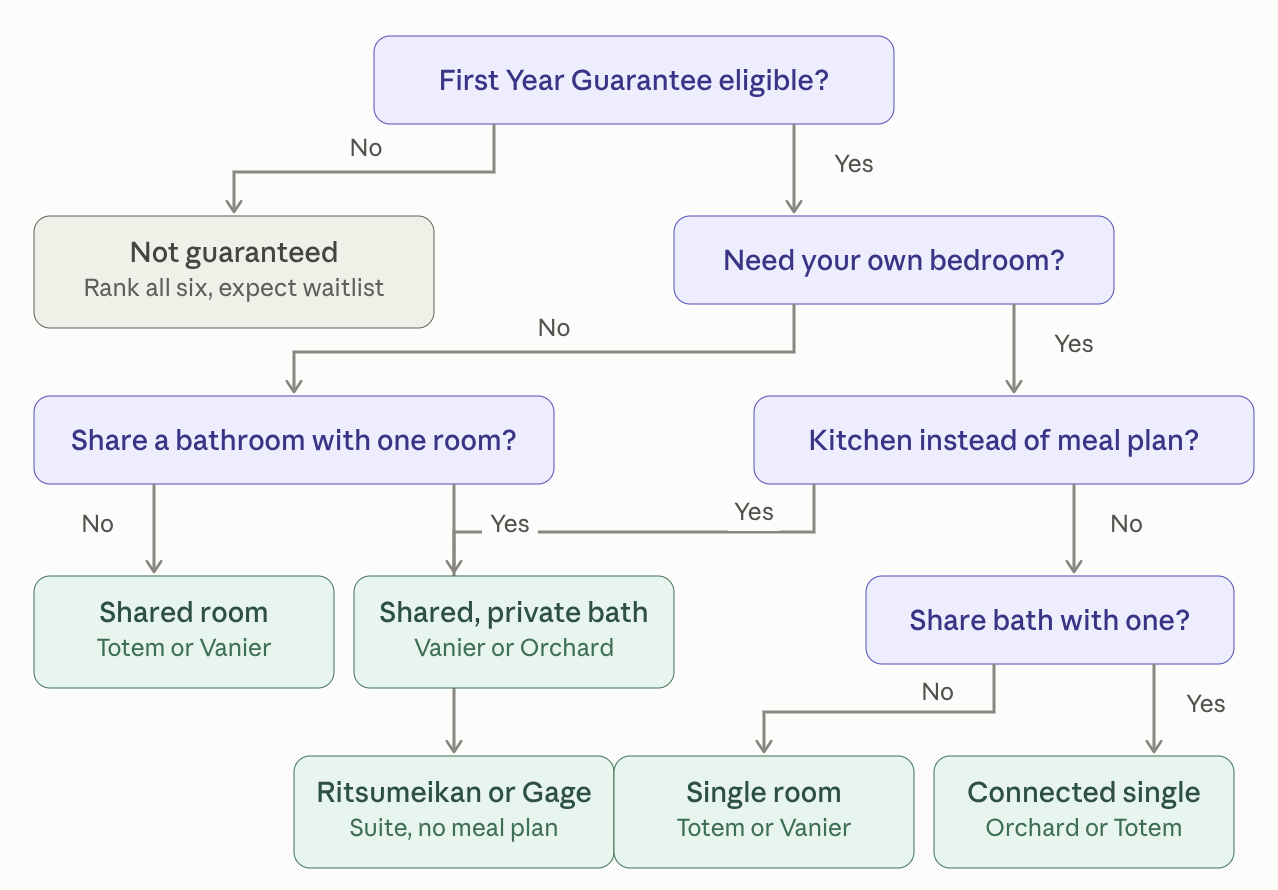
That may sound obvious, but it is an important part of good decision making. Before comparing answers, make sure you understand the question.
Our assessment uses the actual housing structure at your school to help narrow the problem into something manageable. Once we know what choices are realistically available, we can begin looking at which of them fit you.
The goal is not simply to tell you where to live.
It is to make sure that when you do choose, you understand what you were choosing between in the first place.